
December 30, 2025
Async Await JavaScript Programming Guide for Modern Web Applications
 Published by admin
Introduction:
Async await JavaScript programming has become a core skill for developers building modern, scalable applications. As JavaScript applications increasingly rely on APIs, databases, and background processes, managing asynchronous operations cleanly is essential. Async and await provide a readable and maintainable way to handle promises without deeply nested callbacks or complex chaining. This programming guide explains how async await works, when to use it, and how to apply best practices in real-world JavaScript applications.
Understanding the Fundamentals of Async Await JavaScript Programming
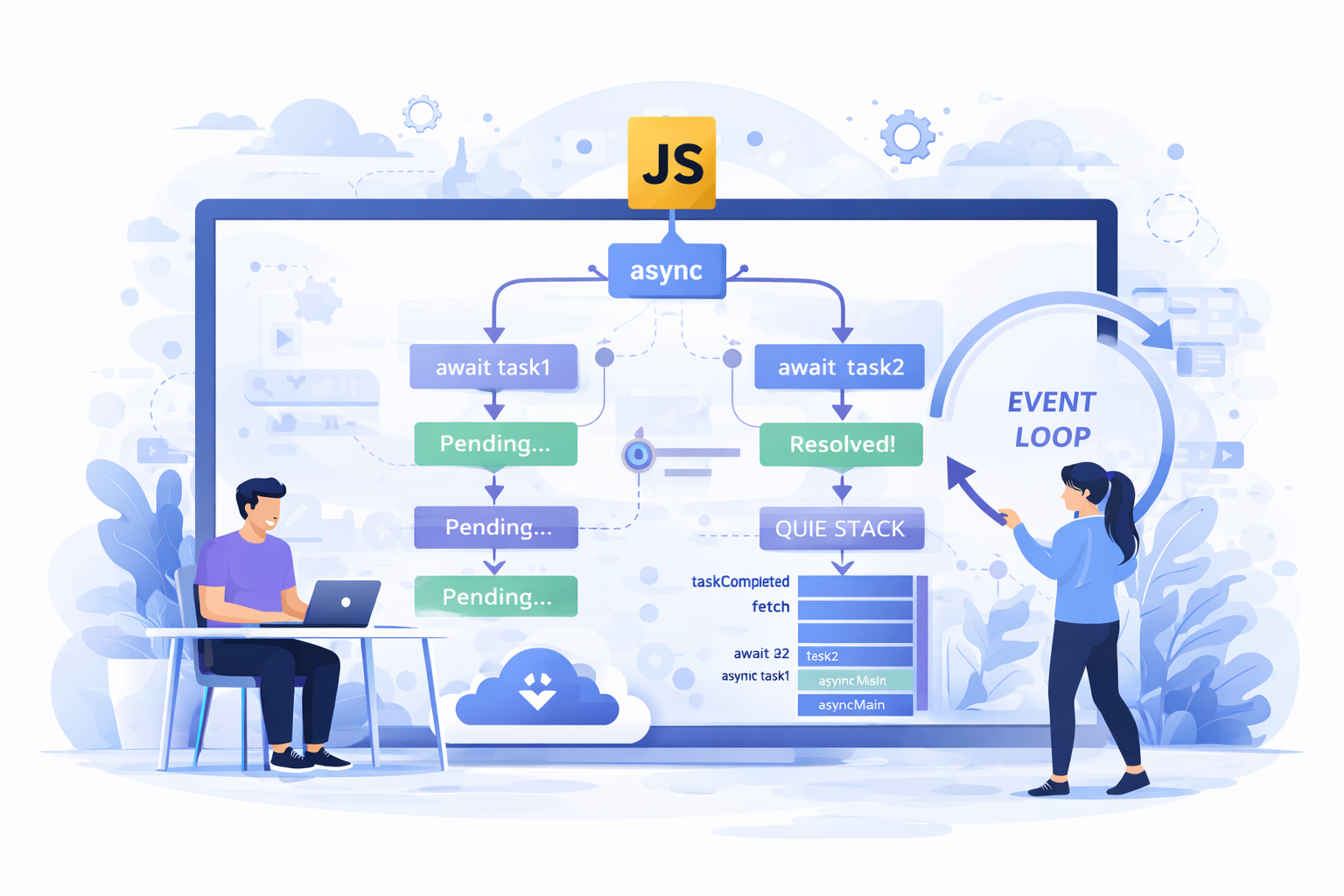
Async await is syntactic sugar built on top of JavaScript promises. The `async` keyword declares a function that always returns a promise, while the `await` keyword pauses execution until the promise resolves or rejects. This allows asynchronous code to be written in a synchronous-looking style, improving readability and reducing mental overhead.
Behind the scenes, the JavaScript event loop continues running while awaited promises resolve. This non-blocking behavior ensures that async await JavaScript programming remains performant, even when handling multiple asynchronous tasks.
Official JavaScript documentation on async functions (MDN): Click Here
How async await improves code readability
Before async await, developers relied heavily on `.then()` chains or callbacks, which often resulted in “callback hell.” Async await flattens control flow, making error handling and debugging easier.
Using try/catch blocks with async await allows developers to handle errors in a familiar way. This is especially useful in large applications where consistent error handling patterns improve maintainability and reliability.
Handling errors and edge cases correctly
Error handling is a critical part of async await JavaScript programming. Any awaited promise that rejects will throw an exception, which must be caught using try/catch. Failing to handle errors properly can cause silent failures or unhandled promise rejections.
Developers should wrap async logic in structured error boundaries and log meaningful error messages. In APIs or backend services, returning standardized error responses ensures better observability and easier debugging.
Error handling best practices in JavaScript: Click Here
Performance considerations and concurrency patterns
While async await improves readability, misuse can lead to performance issues. Awaiting promises sequentially inside loops can slow down execution unnecessarily. Instead, developers should use concurrency patterns such as `Promise.all()` to run independent asynchronous operations in parallel.
Understanding when to await sequentially versus concurrently is key to writing efficient async await JavaScript programming logic. For example, fetching multiple APIs at once should usually be done in parallel to reduce total response time.
JavaScript concurrency model explained: Click Here
Using Async Await in Frontend and Backend JavaScript Applications
In frontend applications, async await is commonly used for API calls, form submissions, authentication flows, and data fetching in frameworks like React or Vue. It simplifies state management and improves code clarity.
On the backend, async await plays a crucial role in Node.js applications handling database queries, file operations, and external services. Clean async patterns reduce bugs and improve scalability in high-traffic environments.
Best Practices for Using Async/Await in JavaScript
To write clean and reliable async await code, developers should:
- Avoid mixing `.then()` with async await in the same function
- Handle all errors explicitly
- Use concurrency wisely with Promise utilities
- Keep async functions small and focused
- Document async behavior clearly in shared codebases
Following these practices ensures async await JavaScript programming remains predictable and easy to maintain as applications grow.
Final Thoughts
Async await JS programming is not just a syntactic improvement—it is a fundamental shift in how developers write and reason about asynchronous code. When used correctly, it results in cleaner logic, fewer bugs, and better performance. Mastering async await enables developers to build scalable, maintainable applications that handle real-world asynchronous complexity with confidence.