
December 25, 2025
Resilient Web Applications with Robust Error Handling and Observability
 Published by admin
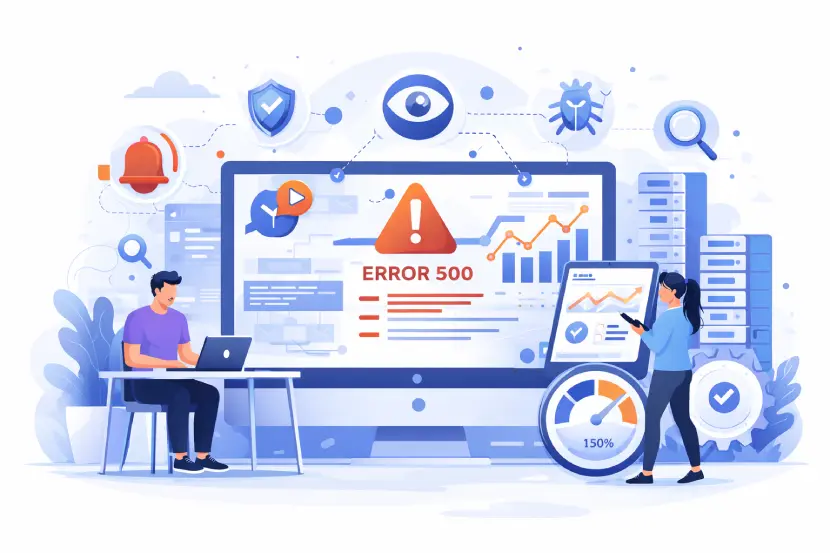
Resilient web applications error handling observability are essential for delivering reliable user experiences in production environments. As modern web systems grow more distributed and complex, failures become inevitable. This article explains how resilient web applications error handling observability practices help developers detect issues early, recover gracefully, and maintain system stability under real-world conditions.
Resilient web applications error handling observability: core principles
Resilient web applications error handling observability start with designing for failure. Instead of assuming perfect execution, systems should expect network errors, service timeouts, and unexpected inputs. Clear error boundaries prevent failures in one part of the application from cascading across the entire system.
Observability complements error handling by providing visibility into what is happening at runtime. Logs, metrics, and traces work together to reveal system behavior. Without observability, diagnosing production issues becomes guesswork, increasing downtime and user frustration.
Structured error handling and recovery patterns
Structured error handling ensures errors are captured, classified, and handled consistently. Client-side applications should distinguish between recoverable and unrecoverable errors, providing meaningful feedback to users when possible. Server-side systems benefit from centralized error handling layers that normalize error responses and prevent sensitive data leakage.
Retry strategies and circuit breakers improve resilience by limiting the impact of transient failures. However, retries must be controlled to avoid amplifying load during outages. Backoff strategies and timeouts help systems recover without overwhelming dependencies.
Implementing observability in modern web stacks
Observability is a foundational requirement for resilient web applications error handling observability. Logging should be structured and contextual, capturing request identifiers, user actions, and error details. This enables efficient correlation across services and faster root-cause analysis.
Metrics provide quantitative insight into system health. Tracking response times, error rates, and throughput highlights performance regressions and capacity issues. Distributed tracing connects requests across services, revealing bottlenecks and failure points in complex workflows.
Monitoring, alerting, and incident response
Effective monitoring transforms observability data into actionable signals. Alerts should be based on user-impacting symptoms rather than isolated technical events. For resilient web applications error handling observability, alerts that trigger on sustained error rates or latency spikes are more meaningful than individual failures.
Incident response processes are equally important. Clear runbooks, escalation paths, and post-incident reviews help teams respond quickly and learn from failures. Continuous improvement ensures the same issues are less likely to recur.
Testing Resilience in Modern Web Applications
Testing is critical for validating resilient web applications error handling observability strategies. Beyond unit and integration tests, developers should simulate failure scenarios using chaos testing or fault injection. These practices expose weaknesses before they reach production.
Load testing combined with failure simulation reveals how systems behave under stress. Observing error handling paths during these tests ensures recovery mechanisms function as intended and observability signals remain accurate.
Final Thoughts
Resilient web applications error handling observability are not optional in modern web development—they are essential. By designing for failure, implementing structured error handling, and investing in comprehensive observability, developers can build systems that withstand real-world challenges. Resilience is achieved through preparation, visibility, and continuous learning, resulting in more reliable applications and better user trust.
Related FAQs
By simulating failures through chaos testing, load testing, and fault injection.
Alerts should reflect user-impacting issues such as sustained errors or latency, not isolated events.
Retries help recover from transient failures but must be carefully controlled to avoid overload.
Observability provides insight into system behavior using logs, metrics, and traces.
It prevents failures from cascading and provides controlled recovery paths that protect user experience.